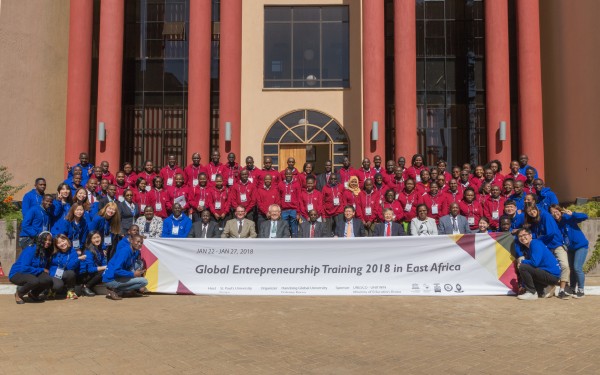
Handong Global University (President Chang Soon Heung) has organized a Global Entrepreneurship Training (GET) program with cooperative university St. Paul’s University (SPU). This event began on January 22nd and will end on the 27th.
Over 100 African neighboring countries including Kenya are participating, and most of the participants are leading figures of these developing nations, such as presently working public officials, entrepreneurs, professors, and preparatory entrepreneurs. Forty people including faculty members of SPU and HGU, coordinators, and student assistant researchers are currently serving in this program.
The GET program has been active since 2007, when Handong Global University was designated as a leading university for UNITWIN (University Twinning and Networking) by UNESCO. The GET program has been in progress for over 10 years with the goal of supporting infrastructure for developing countries and strengthening leaders’ global entrepreneurship competency.
Thus far, official programs were held at least 21 times throughout 10 countries: South Korea, Kenya, Mongolia, Cambodia, Vietnam, Laos, Ghana, Peru, Ethiopia, and Zimbabwe. And the turnout for special short-term course completion is about 2,800 people in total. During these programs, Global Entrepreneurship Education is applied to raise awareness of attendants for developmental issues strengthening the countries’ sustainable developmental capacity and equipping local global entrepreneurs. Moreover, the majority of people who completed GET are already contributing to the economic development of developing countries in the fields of government, private enterprise, educational institutions, and NGOs.
President Chang, Soon Heung remarked, “The key factor that decides the developmental effects of developing countries is their leaders’ ‘heart’ attitude,” and further added, “Participants will be given an opportunity to utilize the comprehensive global entrepreneurship gained through the GET program. Positive outcomes such as economic development in East African regions are expected to increase the efficiency of national resources, lower unemployment rates, and decrease poverty.
Programs take place over a week and they are scheduled on a daily basis, which are as follows: a lecture for faculty members is held in the morning, practical small group activities, such as creating a business plan, and student group presentations take place throughout the afternoon, and in the evening, an assessment for professors.
This program opened with a lecture on ‘Entrepreneurship Mind Set’ the morning of January 22, and will end with a Business Proposal Contest and Awards Ceremony on the closing date, January 27. On the evening of the third day, a special, ‘Culture Night’ will be prepared to encourage interaction among participating students from various countries to share their own cultural values with each other.
Followed by GET, on January 29 and 30, Senior Entrepreneurship Training (SET) will be provided mainly for those who are unable take a long leave of absence, such as high government officials, CEO’s and chiefs of organizations. And Junior Entrepreneurship Training (JET), for high school students, will be hosted by Handong Global University and St. Paul’s University’s student assistant researchers.
※Explanation of Terminology
UNESCO UNITWIN (University Twining and Networking) is a program founded in 1992 by UNESCO. Its purpose is to establish networking systems between universities among developed and developing nations, to bridge the knowledge gap by supporting institutions of higher education and research institutes, and to foster each to be more self-reliant. In 2007, Handong Global University was designated as the first UNITWIN university in Korea.
Along with UNITWIN programs being operated under the Ministry of Education of Korea as a part of ODA business, Handong Global University has made efforts to improve the capacity of higher education institutions in developing countries, mainly those classified as low-income countries by the World Bank. Also, Handong has signed many agreements with universities in developing countries fostering leadership and the development of local communities. Thus far, Handong Global University has been supporting 60 universities throughout at least 20 developing countries as of May 2016.